Are Your Goals Exciting?

With fall upon us, now is the perfect time to think about your future and begin to design the kind of life you’d like to be living. Unfortunately, too many people leave their lives to chance and happenstance, not taking the time to write down their goals and create plans to achieve them. This can be a huge mistake. Not having written goals would be like going on vacation without a destination, something most people would never consider doing. Yet, those same people will leave their futures in the hands of circumstance.

 
Having written goals will change your life. Spend some time thinking about what you’d like your life to be like. For the sake of this exercise, let’s set goals you’d like to have accomplished one year from now. Of course, you can set shorter and longer goals as well.

What would you like for your relationships? How about your health, career, and finances? How about your mind and emotions? What would you like to experience? What would you like to do, be, or have? Invest some time now to identify these things and write them down. This will greatly increase the likelihood of your accomplishing them. If you want to know more about this, there are lots of books, including mine, to help you. That’s not really the topic of this story, however, I’m asking you now to revisit your goals, particularly your short-term ones.

Do they make you want to jump out of bed each day eager to get going? Recently, I was feeling “less than great.” I was even bordering on becoming depressed, something I rarely experience. I felt unmotivated, and wound up being pretty sick for several weeks. Upon closer examination, and because I agree with Socrates that, “An unexamined life is not worth living,” I realized one of the things that I had done was to reset some of my short-term goals to be “more realistic.”

What I had noticed about myself was that in the interest of being realistic, I had lowered my expectations. While this may seem like a reasonable thing to do, in reality, it left me totally uninspired and feeling pretty unmotivated about my goals. For example, if you have a goal of making enough money to “pay the bills” how exciting is that? Is that going to make you jump out of bed in the morning saying, “oh wow, I can’t wait to get going, so I can make money and pay the bills!” I doubt it.

When I understood what I was doing, I immediately set new goals. I set goals that were way beyond my reach. Goals that were huge enough to really get my juices going. Now, when I think about my new, bigger goals, I get excited just imaging what it would feel like reaching them and what my life would be like having accomplished them.

Now, let’s start setting some new goals for the coming year. Following is a simple exercise to help you become clear about your goals and begin creating the life you’ve always wanted.

1. Write what you do want. Be specific. List everything you want to do, be, have, and share for the upcoming year and beyond. Rather than writing “be thinner,” for example, write “I feel & look great weighing 175 pounds.” Instead of writing, “More money,” be specific. How much more per month?

2. Write each goal in the form of a positive affirmation, in the present tense (I am, I have, etc). Set goals in the key areas of your life – spirituality, health, relationships, social, career, things, and money.

3. Next to each one, write why you want this and how you will feel when you have accomplished it.

4. Write at least one small action you can take right now to move toward your goal.

Each day, read your list of goals, concentrating on the feelings associated with having them. The more you can feel the feelings your goal will produce, the faster you can draw it to you. Your sub-conscious mind does not know the difference between that which is real and that which is vividly imagined. Fake it until you make it.

After you reread your goals, seeing yourself as having achieved them, and are feeling the good feelings associated with having them, ask yourself, “What is the next action I can take to move toward this?” Do this daily and watch your life change.


August 11th, 2008 by Jim Donovan

Disturb us, Lord

A Prayer by Sir Francis Drake 1577

Disturb us, Lord, when 
We are too pleased with ourselves,
When our dreams have come true
Because we dreamed too little,
When we arrived safely
Because we sailed too close to the shore.

Disturb us, Lord, when
With the abundance of things we possess
We have lost our thirst
For the waters of life;
Having fallen in love with life,
We have ceased to dream of eternity
And in our efforts to build a new earth,
We have allowed our vision
Of the new Heaven to dim.

Disturb us, Lord,to dare more boldly,
To venture on wilder seas
Where storms will show Your mastery;
Where losing sight of land,
We shall find the stars.

We ask you to push back
The horizons of our hopes;
And to push back the future
In strength, courage, hope, and love.

This we ask in the name of our Captain,
Who is Jesus Christ. 

Six Ground Rules for Handling Conflict in Relationships

 New Life Ministries 

CBN.com 

Set ground rules to make negotiation pleasant and safe. Most couples view negotiation as a trip to the torture chamber. That’s because their efforts are usually fruitless, and they come away from the experience battered and bruised. Who wants to negotiate when it brings nothing but disappointment and pain? So before you begin to negotiate, set some basic ground rules to make sure that you both enjoy the experience.

Ground Rule 1. Try to be pleasant and cheerful throughout negotiations.It’s fairly easy to start discussing an issue while in a good mood. But negotiations can open a can of worms, so be prepared for negative emotional reactions. Your partner may begin to feel uncomfortable about something you say. In fact he or she may suddenly inform you that there will be no further discussion. Try to be as positive and cheerful as you can be, especially if your partner says something that offends you.

Ground Rule 2. Put safety first. Don’t make demands, show disrespect, or become angry when you negotiate, even if your partner makes demands, shows disrespect, or becomes angry with you.

Once the cat is out of the bag and you have told your partner what is bothering you or what you want, you have entered one of the most dangerous phases of negotiation. If your partner’s initial reaction hurts your feelings, you are tempted to retaliate. Your Taker is very persuasive at this point, and unless you make a special effort to resist its advice, your negotiation will turn into an argument. But if you can keep each other safe, you will be able to use your intelligence to help you make the changes you both need.

Ground Rule 3. If you reach an impasse and don’t seem to be getting anywhere, or if one of you is starting to make demands, show disrespect, or become angry, stop negotiating and come back to the issue later.

Just because you can’t resolve a problem at a particular point in time doesn’t mean you can’t find an intelligent solution in the future. Don’t let an impasse prevent you from giving yourself a chance to think about the issue. Let it incubate for a while, and you’ll be amazed what your mind can do when the issue comes up later.

Ground Rule 4. Identify the problem from both perspectives. Once you have set ground rules that guarantee a safe and enjoyable discussion, you are ready to negotiate. But where do you begin? First you must understand the problem from the perspectives of both you and your partner.

Most couples try to resolve a conflict without doing their homework. They don’t fully understand the conflict itself, nor do they understand each other’s perspectives. In many cases, they are not even sure what they really want or what they’re enthusiastically willing to give. When the issue is clarified, the solution is immediately apparent and the conflict is resolved.

Respect is the key to success in this phase of negotiation. Once the issue has been identified and you hear each other’s perspective, it is extremely important to avoid trying to straighten each other out. Remember that your goal is enthusiastic agreement, and there is no way you will be enthusiastic if you reject each other’s perspective. In fact the only way you will reach an enthusiastic agreement is if you come up with a solution that accommodates each other’s perspective.

Ground Rule 5. Brainstorm with abandon. You’ve set the ground rules. You’ve identified the conflict from each other’s perspective. Now you’re ready for the creative part – looking for solutions that you think will make you both happy. I know that can seem impossible if you and your partner have drifted into incompatibility. But the climb to compatibility has to start somewhere, and if you put your minds to it, you’ll think of options that please you both.

The secret to understanding your partner is to try to think like your partner’s Taker thinks. It’s easy to appeal to your partner’s Giver. If she really loves me, she’ll let me do this. Or, he’ll be thoughtful enough to agree with that, I’m sure. But lasting peace must be forged with your partner’s Taker, so your solutions must appeal to your partner’s most selfish instincts. At the same time, they must also appeal to your own selfish instincts.

When you brainstorm, quantity is often more important than quality. Let your minds run wild; go with just about any thought that might satisfy both of your Takers. If you let your creativity run free, you are more likely to find a lasting solution.

Carry a pad of paper or pocket notebook with you so you can write down ideas as you think of them throughout the day. Some problems may require days of thought and pages of ideas. But keep in mind your goal – a solution that will appeal to both of your Takers.

Ground Rule 6. Choose the solution that meets the conditions of the Policy of Joint Agreement – mutual and enthusiastic agreement. After brainstorming, you will have come up with some good and some bad solutions. Now you need to sort through them. Good solutions are those both you and your partner consider desirable. Bad solutions, on the other hand, take only the feelings of one partner into account at the expense of the other. The best solution is the one that makes you and your partner enthusiastic.

Many problems are relatively easy to solve. You will be amazed at how quickly you can come to an enthusiastic agreement for some problems when you have decided to hold off on any action until you both agree. That’s because when you know you must take each other’s feelings into account, you become increasingly aware of what it will take to reach a mutual agreement. Instead of considering options that clearly are not in your partner’s best interest, you reject them immediately and begin to think of options you know would make both you and your partner happy. You will be much smarter when you direct your mind to find only smart solutions.

So if you have tried to follow my advice but cant’ seem to negotiate with each other regardless of how hard you try, addiction may be the culprit. In fact a good way to determine if you are addicted to a substance or activity is to see if you can follow the Policy of Joint Agreement after you have agreed to it. If you find you can’t, you may need professional help to overcome your addiction. But once it’s overcome, the Policy of Joint Agreement will help you from returning to it later.

Effect of music on cognitive function


Playing an instrument seems to make learning math and foreign languages easier, but researchers aren’t sure why.

Taylor Bredberg is an ardent fan of the indie band Grizzly Bear and the TV series “Lost,” an amateur filmmaker and a doodler of figures that bring to mind Tim Burton’s kinetic grostesques.

But if those interests make him a pretty normal teenager, Bredberg’s eight-year relationship with the piano may have made him a little more unusual: He is a kid with the attention span of an anesthesiologist, the persistence and discipline of an Olympic athlete and the emotional range of an artist.

“Piano has shaped me, yeah,” says Bredberg, who began taking lessons after his family discovered him, at 7, plinking out on his own the pieces his older sister was learning in lessons. “In terms of discipline and creativity, I’d have been a much different person if I hadn’t played piano.”

Once a week, Bredberg studies the instrument at the elite Colburn School for Performing Arts in Los Angeles. And he practices for several hours a day, favoring pieces by the Russian composers who are his favorites: Rachmaninoff, Prokofiev, Shostakovich and Stravinsky. When he feels more delicate, he favors Debussy.

As a freshman, Bredberg has been learning to speak Russian as well, and he finds Algebra 2 a cinch. “It’s always been pretty understandable to me. It’s very logical,” he says. He recognizes the challenge of learning math as one that requires the same methodical patience it takes to learn Prokofiev’s 3rd Sonata in A minor, his current project: “I’ve just gotten used to repeating one phrase until I can play it at the proper speed, and well, and musically,” he says. “I guess that can contribute to not getting frustrated after having to repeat so many [math] problems.”

Kids like Taylor Bredberg underscore a key problem that researchers have in understanding the link between music-making and cognitive performance. Bredberg hails from the kind of educated family in which music instruction is more common to begin with — an environmental advantage that may account for his particular mental strengths. To truly learn what music-making can do for academic skills, researchers say they must pluck kids from a wider range of family environments and offer them music lessons, rather than just study kids whose families have sought out musical instruction for them. That’s the only way they will be able to disentangle the effects of early environment from those of musical instruction, they say.

Los Angeles : CA : USA | Feb 27, 2010
Source: Los Angeles Times

10 Powerful Self Defense Tips For Women

In the USA, every two minutes a woman is being raped.

A 1993 survey revealed that 50% of Canadian women have experienced an incident of sexual assault or physical violence.

In Australia, 19% of women aged 18 to 24 experienced an act of violence in the last year.

Statistics show that one in very four women in America will be sexually assaulted in her lifetime.

These are SHOCKING statistics!

For more than 30 years I have been running specialized self defence courses and seminars. Over that time I have shown thousands of people how to protect and look after themselves.

Increasing personal safety ALWAYS commences with awareness.

Since most women fear attacks of a sexual nature more than anything else most of my quick tips are geared towards that.

If you are a woman, here is a list of ten simple things that you can do immediately that will increase your safety:

1 – Do not wear revealing clothing in public places. Doing so will ensure that you attract plenty of attention, including attention from those people with evil intent. Be discrete and leave provocative wear to those times when you can enjoy the intimacy of your partner.

2 – Trust your instincts. Women are very intuitive. If you think a situation might be dangerous then it probably is. That little guardian angel should be trusted rather than ignored.

3 – Rape and other sexual assault is always increasing. In the event of the worst outcome use your fingernails to gouge your attacker’s cheek. It marks him for identification and you will have DNA under your nails.

4 – Drive your motor vehicle in a courteous manner. Nobody appreciates rude hand signs. Remember – eventually you have to stop, even if it is to refuel. Psycho cases might follow you for many miles “just to teach you a lesson” – all because you made yourself a target to their twisted minds.

5 – Drinking excessive amounts of alcohol, taking mind altering drugs and leaving ANY food or drink unattended where it may be tampered with is a recipe for disaster. Give your self an even chance.

6 – NEVER pick up hitch-hikers and ABSOLUTELY NEVER hitch-hike yourself.

7 – If you live alone make sure that all your mail is addressed by just your first initial followed by your surname. Never allow mail to be addressed to you with salutations like Miss, Mrs, Ms or with your christian or given name. Those letters and parcels pass many eyes before they get to you. Change them. Make them nondescript as to your sex and marital status. Why allow anybody even one extra shred of information about you?

8 – NEVER walk alone at night or at any time in isolated areas. Predators love these locations. Avoid them.

9 – Many sexual acts are committed by people who the victims knew – or, at least, thought they knew! Be friendly and polite by all means but be vigilant for tell-tale signs of “strange” behavior. Do NOT flirt. Be firm about any unwanted attention, particularly in the work place.

10 – Sexual attack is usually preceded by some visual sign, which is usually preceded by some verbal approach before the physical action. Recognize the sequence: the look – the talk – the attack.

Please feel free to distribute this safety list to every woman you care for. The only condition is that the resource box remains intact and that this article is not altered in any way.

There are so many predators out there. Let’s help our women to PROTECT themselves! Don’t let somebody YOU know become the next victim

Sa Ugoy ng Duyan

 
Ang tanong:
If you’re given the chance to travel back in time, what event in the past will you visit first?

Ang Sagot: 
Childhood. Ang lahat ng pangyayari sa aking kabataan. Ang aking kamusmusan; ang mga masasayang sandali ng simpleng buhay sa piling ng aking – minsa’y kinainggitang – ulirang pamilya.
Back when I was I child, before life removed all the innocence, ika nga ng isang kanta ni Luther Vandross. Nagpapasalamat ako sa aking mga magulang dahil napagtanto kong hindi pala lahat ng tao ay nakakaranas ng kamusmusan.
Oh, kaysarap bumalik sa nakaraan. Ang family bonding – ang kainin sa labas kasama ang buong pamilya at ang free ice cream spree that I get to enjoy. Ngayo’y naglaho na. Krisis sa pera, krisis sa pamilya – grabe naman talaga oo, laki ng impact ng sinasabing recession. Hay buhay.

Iiwanan ko kayo ng isang kanta. *classic. Brings back the old times


Sa Ugoy Ng Duyan

Lucio San Pedro


Sana’y di nagmaliw ang dati kong araw
Nang munti pang bata sa piling ni nanay
Nais kong maulit ang awit ni inang mahal
Awit ng pag-ibig habang ako’y nasa duyan

Sana’y di nagmaliw ang dati kong araw
Nang munti pang bata sa piling ni nanay
Nais kong maulit ang awit ni inang mahal
Awit ng pag-ibig habang ako’y nasa duyan

Refrain:
Sa aking pagtulog na labis ang himbing
Ang bantay ko’y tala, ang tanod ko’y bituin
Sa piling ni nanay, langit ay buhay
Puso kong may dusa sabik sa ugoy ng duyan

Sana’y di nagmaliw ang dati kong araw
Nang munti pang bata sa piling ni nanay
Nais kong maulit ang awit ni inang mahal
Awit ng pag-ibig habang ako’y nasa duyan

Sa aking pagtulog na labis ang himbing
Ang bantay ko’y tala, ang tanod ko’y bituin
Sa piling ni nanay, langit ay buhay
Puso kong may dusa sabik sa ugoy ng duyan

Nais kong matulog sa dating duyan ko, inay
Oh! inay


Credits to Mr. Rowie Tokie


Sangguniang Kabataan (SK) and Barangay Elections

“A politician is a fellow who gives you the key to the city after he’s taken everything worth having.”

Ang Tanong: Bakit maraming tumatakbo t’wing eleksyon?

Ang Sagot: Simple lang. Para maging parte sila ng isang malaking samahan ng mga kolektor, na kilala sa tawag na GOBYERNO.


All Systems ‘Green’. It’s election time again on the local scene. Happy days are here again. Or is it? But wait, allow me to tell a story which I got from a piece entitled Election Merry-Go-Round. One. Two. three. Shoot. 

It is told that a couple tried to find out what their son wanted to be when he grew up. They placed a fresh 20-peso bill on the table to represent the banker, then placed a Bible to represent a clergyman, and a bottle of whiskey to represent a bum. Then the parents hid themselves.
Soon, Johnny, their son, came in whistling, saw the arrangement on the table, picked up the bill, peered through it against the light, replaced it, took up the Bible, flipped its pages, then uncorked the bottle and smelt the contents. He then looked around and seeing no one, he picked up the bill, stuffed it into his pocket, took the Bible and lodged it under his arm, then grabbed the bottle by the neck and slid out of the room quickly, still whistling.

“My goodness, Mama!” cried the father, “He’s going to be a politician!”
Today, we have so many of these creatures. Lucky for us – more often than not, there are usually two candidates vying for the same position for us to choose from – and mercifully, we have to elect only one of them.*wew

But beware! According to the same piece, politicians readily learn from experience. Here are some principles they never fail to observe:
→In traffic, when in doubt, Stop!
→In war, when in doubt, Shoot!
→In politics, when in doubt, Terrorize!
→Of course, when defeat is certain – CHEAT!
Okay-Okay let us not give this stereotypical image to all politicians there but – yes! animals with these such off-putting principles do exists.


But Wait! There’s more! Sangguniang Kabataan *SK (Sangguniang Kalokohan?). Ah! Ang SK, naaalala natin sila sa mga liga na pinapasinayaan nila twing summer para sa mga kabataan. Kilala rin natin sila sa mga padisco pagkatapos ng mga programs. At minsan, nagpapaskil sila ng mga signboards o paalala na mas malaki pa ang katagang Sangguniang Kabataan kesa sa nilalaman, which is, ayos naman kung gusto mo talagang malaman kung sino nagpost nun, at hindi mo mawari kung ung mga posts na iyon ba eh nagpapaalala o nagpapatawa. 


Here’s what a blogger has to say about SK:
Listen, SK does not work. Not in my lifetime. If once upon a time it did, it doesn’t anymore. Kids nowadays are so busy with pretty much everything else that they cant even be bothered to check the news that doesn’t involve the cancellation of classes. The only ones who are interested in SK are those who are already looking into running for mayor even at an early age, like say five, presumably because our local government positions are now run like family businesses. Source: Public Static


How we wish that this elections will not only be free, honest and clean, but also that the electorate would march to the polls with an enlightened heart and mind.
As it has been said, wisdom descends from experience. Let us all vote wisely. Here’s hoping the best man wins (or woman, in any case).


Overall. In our placethe local election process is peaceful, most especially in our Barangay. Thank God. I think hope is in the air. I can smell it, I can feel it; or at least that’s what the positive side of my mind is telling me.

Credits to Mr. Rowie Tokie

The Hope of Music’s Healing Powers

 Yes, yes, it hath charms to soothe a savage breast (or beast, if you prefer to repeat a common mistake). But researchers are finding that music may be an effective balm for many other afflictions: the isolation of conditions such as autism and Alzheimer’s disease, the disability that results from stroke, the physical stress of entering the world too early.


The hope of music’s curative powers has spawned a community in the United States of some 5,000 registered music therapists, who have done post-college study in psychology and music to gain certification. Active primarily in hospitals, nursing homes, special needs classrooms and rehabilitation units, music therapists aim to soothe, stimulate and support the development or recovery of abilities lost to illness or injury.

While music therapists use a mix of improvisation and proven techniques to help patients, neuroscientists are looking to uncover the scientific basis for music’s healing powers. They are trying to understand how music can help rewire a brainaffected by illness or injury, or provide a work-around for injured or underperforming brain regions.

By doing so, they hope to better identify which patients might respond best to music and what musical techniques might best help them to regain lost or compromised function.

“Music might provide an alternative entry point” to the brain, because it can unlock so many different doors into an injured or ill brain, said Dr. Gottfried Schlaug, a Harvard University neurologist. Pitch, harmony, melody, rhythm and emotion — all components of music — engage different regions of the brain. And many of those same regions are also important in speech, movement and social interaction. If a disease or trauma has disabled a brain region needed for such functions, music can sometimes get in through a back door and coax them out by another route, Schlaug says.

“In a sense, we’re using musical tools to particularly engage certain parts of the brain and then teach the brain new tricks — new tools — to overcome an impairment,” he says.

Neuroscientists are exploring the role of music in treatment of some of the following:

Speech: For about 1 in 5 patients who suffer a stroke, difficulty with speech — aphasia — is a lingering effect. Schlaug and other researchers have found that by practicing to express themselves with a simple form of singing — something that sounds almost like Gregorian chant — aphasic stroke victims significantly improved the fluency of their speech compared with patients whose speech therapy did not include singing.

Schlaug says it appears that the “melodic intonation therapy,” as it’s termed, bypassed the stroke damage done to speech centers in aphasic patients’ left brain hemisphere. Instead, it engaged and recruited areas of their healthy right hemispheres that were capable of — though not generally used for — word acquisition and speech.

The patients tapped along as they sang, which also seemed to engage a broad network in the brain involved in detecting and reproducing rhythm. Such strategies, it turned out, allowed aphasics’ words to come out.

Movement: If you’re old enough, recall John Travolta walking down the street to the song “Stayin’ Alive” in the opening scene of “Saturday Night Fever.” Now imagine a patient with Parkinson’s disease, a degenerative brain condition that affects the initiation and smooth completion of movement. Here’s where music’s rhythmic qualities appear to get in the back door of a patient’s brain and provide a work-around to brain functions degraded by Parkinson’s. By engaging the network of regions that perceive and anticipate rhythm, music with a steady, predictable beat can be used to cue the brain’s motor regions to initiate walking.

Once off the dime, a Parkinson’s patient can use the music’s beat to maintain a steady, rhythmic gait, like John Travolta.

“It works well and it works instantaneously, and it’s hard to think of any medication that has this effect,” Schlaug says.

Neuroscientists suspect that music may work in much the same way for stutterers, who can experience difficulties initiating speech and maintaining a steady flow of words. Case studies have long observed that when stutterers sing, their halting speech patterns disappear. Music’s predictable beats may help them initiate speech and continue fluently.

Reading: Research suggests that people with dyslexia, or difficulty reading, also fare poorly on tests of auditory processing. Their timing is also poor. They have difficulty filtering out unwanted background noise and “tuning in” to sounds — such as a teacher’s instruction — that they want to hear. Intensive music instruction has been found to improve those skills, and with them, some skills related to reading.

Memory: The progressive degeneration of memory in Alzheimer’s disease cannot be reversed or slowed by any intervention. But music can temporarily unlock memories for patients who have lost their grip on nearly every other detail of their daily life and relationships.

Patients in the depths of Alzheimer’s and other dementias regularly respond to — and even play and sing — music from their distant past, without missing a word or a note. Nursing homes have seized upon that fact, exposing residents to the songs of their childhoods or courtship years to help reunite spouses in dancing and singing and try to coax dementia sufferers from their isolation. One study even found that dementia patients allowed to punch a button on a robot and hear a familiar song experienced improved mood, function and performance on musical memory games.

Preemies’ weight gain: An Israeli study, published December in the journal Pediatrics, found that playing Mozart quietly in neonatal intensive care units supported the weight gain of premature infants by slowing their rate of energy expenditure. Babies exposed over two days to 30 minutes of music (drawn from, yes, an Israeli “Mozart for Baby” CD) slowed their metabolisms, helping to accelerate their growth.

Whether Mozart is worth using routinely in neonatal care units, the researchers say, will take further study.

Source: Los Angeles Times

Los Angeles : CA : USA | Feb 27, 2010

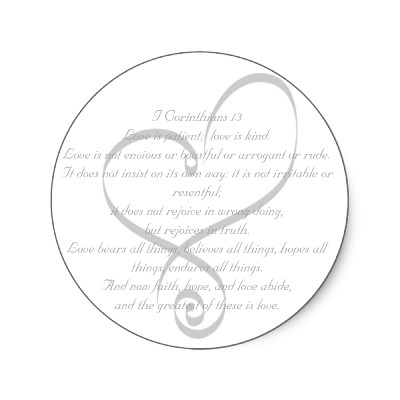
The Love Chapter-1 Corinthians 13 (The Message)


1 If I speak with human eloquence and angelic ecstasy but don’t love, I’m nothing but the creaking of a rusty gate. 2 If I speak God’s Word with power, revealing all his mysteries and making everything plain as day, and if I have faith that says to a mountain, “Jump,” and it jumps, but I don’t love, I’m nothing. 3-7 If I give everything I own to the poor and even go to the stake to be burned as a martyr, but I don’t love, I’ve gotten nowhere. So, no matter what I say, what I believe, and what I do, I’m bankrupt without love. 
   Love never gives up.    Love cares more for others than for self.    Love doesn’t want what it doesn’t have.    Love doesn’t strut,    Doesn’t have a swelled head,    Doesn’t force itself on others,    Isn’t always “me first,”    Doesn’t fly off the handle,    Doesn’t keep score of the sins of others,    Doesn’t revel when others grovel,    Takes pleasure in the flowering of truth,    Puts up with anything,    Trusts God always,    Always looks for the best,    Never looks back,    But keeps going to the end.
8-10 Love never dies. Inspired speech will be over some day; praying in tongues will end; understanding will reach its limit. We know only a portion of the truth, and what we say about God is always incomplete. But when the Complete arrives, our incompletes will be canceled.
11 When I was an infant at my mother’s breast, I gurgled and cooed like any infant. When I grew up, I left those infant ways for good.
12 We don’t yet see things clearly. We’re squinting in a fog, peering through a mist. But it won’t be long before the weather clears and the sun shines bright! We’ll see it all then, see it all as clearly as God sees us, knowing him directly just as he knows us!

13 But for right now, until that completeness, we have three things to do to lead us toward that consummation: Trust steadily in God, hope unswervingly, love extravagantly. And the best of the three is love.

Music is good for you at any age

Let’s face it: Many of us looking to sharpen our intellectual edges have already passed the age when becoming a prodigy is an option. We missed the opportunity to start clarinet lessons at 5. We lacked the discipline to practice for hours on end. We were told we couldn’t carry a tune in a bucket.

It’s never too late, say researchers.

Just as second languages are more easily learned young, neuroscientists point to periods of heightened sensitivity — particularly before the age of 8 or 9 — when minds are more readily shaped by musical instruction.

With age, the “plasticity” that allows experience to mold the brain so easily declines. But it doesn’t disappear. At any age, learning a challenging new set of skills such as instrumental music is likely to return cognitive dividends, says Harvard University neurologist Gottfried Schlaug. And for adults, he added, the prospect of making music can be a far more effective motivator to practice than nagging parents are to younger musicians.

“Music is sort of the perfect activity that people can engage in from young to older years. It affects how the brain develops and affects how the brain changes in structure” at any age, Schlaug says.

For the mature brain, even listening to beloved music may have what scientists call a “neuroprotective” effect.

Dr. Antonio Damasio, director of USC’s Brain and Creativity Institute, is an expert on emotion and a committed musicophile. Even if music did little more than lift our spirits, he says, it would be a powerful force in maintaining physical and mental health. The pleasure that results from listening to music we love stimulates the release of neural growth factors that promote the vigor, growth and replacement of brain cells.

In that way, Damasio says, just the simple act of absorbing music may help keep older minds healthy, active and resilient against injury and illness.

Design a site like this with WordPress.com
Get started